Same guy- new name - new website!

You will be automatically redirected to the new address. If that does not occur, visit
http://InspiredRemodeling.com/blog
and update your bookmarks. Thanks! -Peter

Saturday, May 8, 2010

Help! The Shower is Spraying on the Walls!

It's not that unusual to see an older home with a bathroom originally designed to have just a bathtub with no shower. Often, these are also right in front of a window too, making it that much more fun, right? (See this post)

This bathroom was built with just a tub, but a shower head was added later. The problem was that the upper walls were still just painted drywall. The homeowner asked me to extend the old bath surround up to the shower head with matching white tile.

Before laying the tile, I installed Schluter Kerdi over the drywall. It's a waterproofing membrane that will protect the drywall from moisture. It's the same material that is often used when tiling a shower (See this post). It also saves the mess of tearing out dryall and replacing it with cementboard in this case.

I was prepping to lay out the tile when I realized that those old tiles were not exactly the same size as my new ones. The old ones were 4 3/16" while the new tiles are 4 1/4". This is only a 1/16" difference, however, this is enough to really mess up the grout lines and change the entire layout. I called Louisville Tile to see if they still made tiles of the smaller size and they said I wouldn't be able to find them anymore. The solution- cut a 1/16" off of every tile!

Thankfully, the height of the tile was fine because I wasn't matching any old tile on the sides. I just had to cut off 1/16" from one side of each tile. I set fence on my tile saw the right dimension and set out to cut close to 200 tiles. (Not that I was counting, right?)

With that figured out, the tile went in very quickly, and I was on my way. I grouted it with unsanded white grout and sealed it after that. As expected, you can tell where the new tile starts, but at least the walls will stay dry!

-Peter

Friday, May 7, 2010

Most Serene Jobsite Award Goes to...

I love spring. I always get the landscaping fever and end up ordering unusual plants to put somewhere around our yard. This year the weirdest is a giant plant called "Dinosaur Food". :)

Anyway, I was working last week at an home in the older part of Old Hickory that has to get the award for one of the most pleasant places to work. The yard was just full of all kinds of well-groomed and cared for plants. All of this next to a front porch that spanned the entire front of the house with a very inviting porch swing.

I was working right in the middle of it all, mixing grout for tile and cutting some flooring for the kitchen.

-Peter

Thursday, May 6, 2010

Makeover the Bathroom With a Tile Floor

This recent project involved laying a tile floor in a new home that was originally built with vinyl around the toilet/tub and carpet around the vanity. This is quite common in newer homes, and it's any easy spot to upgrade and completely change the feel of the room.

The vinyl and carpet had to get ripped out and then I worked on a layout for the tile. The home was built on a cement slab so there was no reason to add extra cementboard before tiling. This makes the project move along quickly and saves the homeowner a little money as well.

These were 12" tiles, but this shade comes in various sizes. You can get as fancy as you want if you mix others in to come up with a pattern.

-Peter

Tuesday, May 4, 2010

How About Some Tile Above the Surround?

Many newer homes are built with a standard fiberglass bathtub surround. It still works so you hate to remove it, but maybe you'd like to spruce it up a little. These homeowners asked me to add some tile around the top of theirs as I was working on their floors.


The bathroom had been wallpapered, which looks nice, but sometimes tends to curl up around the shower because of moisture. Some tile above the surround will help this as well.

To start, I removed the wall paper down to the drywall. The tile I was installing were 4" x 4" squares that matched the tile I would be laying on the floor next. The homeowner had picked up a handful of accent tiles that I staggered around the surround.

The result was nice, but will be even better when I get the floor done, and that's coming soon!
-Peter

Thursday, April 29, 2010

Grouting Porous Tile

One of the things that the homeowner loved about the tile I used for the backsplash (see this post) was the look of the porous tumbled marble. Most of the tiles were very textured, with some having decent sized impressions and holes in them. It's always recommended that you seal the tiles before grouting to help keep the grout out of the tile, however, with porous stone, the grout will still fill all those voids. So there are a couple of ways you can approach grouting these tiles.

ONE WAY- FILL THE HOLES
Probably the most common way is to just grout it all and fill the holes. They will still have the character of the porous stone, but the deeper pores will be mostly filled with grout. This is usually the best method because if you don't fill the pores, they will eventually get dirt in them or even food particles if it's around the countertop. These will be a major headache to try to clean later if they aren't grouted.

If you're filling the pores with grout, I'd suggest using a grout color that matches the stone. If you use a highly contrasting grout color, the filled pores may not look as natural.

ANOTHER WAY- DON'T FILL THE HOLES
Okay, you probably aren't going to be able to keep grout out of all the pores, however, you can use painter's tape to cover the faces of the tile if you want to keep the grout out. If you've got the desire and the time, you could actually tape the face of every tile.

I used this method with the backsplash to cover the pores on just a select few tiles that had the most character, trying to have some consistency throughout the backsplash. I used some larger blue painter's tape and cut it with scissors (rather than tearing it). This makes a clean cut that lays flatter against the stone making it easier to grout over.

After taping the stones I wanted to preserve, I grouted as normal right over the tops. I removed the tape after I had already sponged off the grout a couple times. The tape worked great and the homeowner loved the texture that it left in the tumbled marble.

Of course, when you're finished it needs to be sealed again, this time focusing on sealing the grout.

-Peter

Tuesday, April 20, 2010

A Tumbled Marble Backsplash Spices Up This Kitchen

Sometimes a kitchen can be quite nice and still lack a little 'wow-factor'. It was time to add some of that to this kitchen with a new tumbled marble backsplash.

The homeowners have great taste and had picked out a handful of various tiles that they liked. We talked over the layout and tried a few combinations before coming up with the final design.

The bottom 6" features a mosaic pattern made up of various shapes and colors of the stone. Above that I would use 4" square tumbled marble set on the diagonal. I was excited to get started.

The backsplash tile can be installed right over the drywall, provided that it is smooth and not damaged. This saved some prep time and I jumped right into getting the layout right. With this many different tiles involved it's tricky to not end up with small pieces of tile somewhere in the layout.

I laid the tile out on the countertop with spacers to get an idea of the design and measure the actual size of things. Then I installed the mosaic tile all the way around. It actually came on a 12" x 12" sheet that I cut in half. The slowest part is always cutting all those pieces that go around the outlets.


With the bottom tiles ready, I started laying out the top tiles on the diagonal. The second row of 4" tiles would alternate between the natural white and a chocolate-colored tile to add more interest. I wanted this to lay out so that the spacing of the accent tiles would not look awkward.

I used a sanded grout to finish it up. This is recommended because even though some of the joints are 1/8" or less many of the spaces are much larger because of the rough, uneven edges of the tiles. I sealed the tiles with two coats of sealer before grouting which is supposed to help the grout not get absorbed into the face of the tiles as much.

In the end, the backsplash looked remarkable and the colors blended perfectly with the maple cabinets and the solid surface counter.

-Peter

www.CarpentryGuy.com

Monday, April 12, 2010

Tile and Finish the Shower Floor Repair

I covered the basics of waterproofing a shower using the Schluter Kerdi system in my last post (click here). Now it's time to lay the tile and grout it all.

The goal of this project was to just to replace the bottom rows of tile and the shower floor. The older system was leaking and needed to be torn out (see this post). In addition to leaking, the old tiles weren't looking very good and some dirt had been collecting in areas that had been caulked several times in an attempt to fix the leaks.

The layout for the tile was already dictated to me by the original tiles that I didn't remove. I would be using a rounded base tile at the intersection of the bottom of the wall with the floor. This piece would get cut to fit after I installed the wall tiles.

In this case, I would need to start laying tile at the top and go down from there. If you start at the bottom, the weight of the tile is supported by the floor. Starting at the top, I had to tape each piece to the tile above so that they wouldn't slide down the wall and out of place.

One great thing about the Schluter Drain is that is a 4" square. It's perfectly sized for most tile installations where you are using either 1", 2", or 4" tiles. In my case, I installed 2" square white tiles by cutting out the center of one sheet of tile and installing this first (see the picture below). Then I installed all the tile sheets around the perimeter.


The small ledge across the bottom of the doorway is called the curb. It keeps the water contained in the bottom of the shower. I used some curved edge pieces of tile on the corner of the curb to avoid any sharp corners.

After grouting with white unsanded grout and sealing, this shower was ready for business. Hopefully, it will last for decades to come with no more problems.

HINT: John Bridge (Tile guy extraordinaire at www.JohnBridge.com) says that for a maintenance-free shower, take a minute after each use to wipe down the tile with a towel. This will greatly reduce any mildew over time and keep it cleaner as well.


-Peter


www.CarpentryGuy.com

Thursday, April 8, 2010

Waterproof the Tile Shower With Schluter Kerdi

What the heck is Schluter Kerdi???


It's a fairly new system for waterproofing showers that involves installing a membrane (the Kerdi) throughout the shower and over their special Kerdi drain. When finished you'll have a completely waterproof, sealed shower. In fact, it's so waterproof that you can install the Kerdi right over regular old drywall. That says a lot.

Let's look at how I installed the Schluter Kerdi shower system when I was repairing and old leaky shower pan liner that was decades old. In my last post (this link), I tore out the old tile down to the framing. Next, I replaced the subfloor with new plywood and added 1/2" Hardibacker on the walls. (Yes, I could have used 1/2" drywall, but I had the Hardibacker on hand...)

INSTALL THE PRE-SLOPED SHOWER TRAY
The older method to doing a shower floor included making a sloped bed of mortar that would direct water toward the drain. This needed more time, labor and expertise. For this shower, I used a Schluter pre-sloped shower tray. It's made out of some kind of foam and is easily cut to fit your particular shower.


After cutting the tray to size, I dry-laid it in place to mark the spot for the drain. Once the drain hole was cut out, I covered the floor with unmodified thinset mortar using a 3/16" v-notch trowel. The shower tray sets in this. You can walk around on it to make sure it's well embedded in the mortar. Just be careful not to crush it with your knees as you are working- it is foam after all.

INSTALL THE KERDI MEMBRANE
I'm not going to go through every detail of installing the membrane. If you are interested make sure to get the Schluter installation DVD and check out www.Schluter.com. The DVD comes with the shower kit and is great at showing every step along the way.

Basically, the membrane is installed over a thin layer of mortar and then flattened out and embedded using the straight edge of your trowel. The edges must all overlap by a minimum of 2". I started by using something they call Kerdi-Band in all the bottom corners. (It's just a thin pre-cut strip of the Kerdi material.)


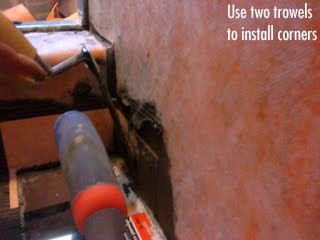
It helped to have two trowels or a putty knife so you can hold the membrane in the corner with one trowel while you smooth out the other side with the other one. It's important to have tight square corners so that your tile will fit together correctly.

Once all the corners are done I installed larger pieces of Kerdi on the walls that overlap the corner pieces. Smooth them out to make sure there aren't any air bubbles underneath. Schluter also makes special corner pieces that a pre-formed to fit into corners and over the curb corners.

INSTALL THE KERDI DRAIN

The walls are done- let's do the floor. I covered the floor with a layer of mortar and then pressed the Kerdi Drain into place. The flange has openings that will help it firmly integrate into the mortar. I spread a little more mortar around the flange and installed the Kerdi membrane, making sure to fully embed it, especially around the drain.

That's it! Let it set overnight and we'll be ready to install the tile.

-Peter

www.CarpentryGuy.com

Tuesday, April 6, 2010

Redo a Tile Shower Floor- Tearout

Tile shower floors are nice, unless they are leaking! This is the case for a Nashville homeowner that asked me to repair their shower floor.

This was an old shower that was likely 40-50 years old. The way of installing a shower back then (and still today in some cases) was to first install a waterproof membrane that goes around 8" up the walls all the way around. Then, a sloped bed of mortar or 'mud' is installed before tiling the floor. A specific type of drain is used that makes a seal with the membrane.

Many people have the misconception that grout is waterproof. This is not true. Most of the water is deflected and just goes down the drain, however, a small amount is absorbed through the grout and mortar. When it gets to the waterproof membrane the water is funneled to the drain and through tiny 'weep holes' that send the water down the drain.

My guess is that the weep holes were clogged with this shower. This meant that the mortar bed was saturated with water and it was full enough that it was dripping over the top of the membrane around the sides. I saw evidence of this when I started removing the bottom tiles and water started pouring out from behind.

TEAR IT OUT
The homeowners didn't want to replace the entire shower and I can't blame them. This is expensive work. Instead I would just be tearing out the bottom few rows and installing a new waterproofing system called Kerdi from Schluter Systems. First, I had to get dirty.

Getting started was easy because many of the tiles were loose anyway and came right off. After that I went around with my hammer and a flat bar and busted out the tile. Of course, I was careful not to damage the tile above that I wanted to keep.


The wall tiles were set on a mortar bed containing wire mesh for strength. Below that was the black shower membrane that had to go. It all chipped away fairly easily exposing the thick mortar bed under the floor of the shower. This mortar didn't contain any mesh and broke apart into pieces that I could just scoop up and dispose of.

Finally, I had worked my way down to the subfloor that was wet and needed to be cut out. It wasn't long before I was looking into the basement and ready to start putting it all back together.

-Peter

Thursday, April 1, 2010

Finishing Up the Marble Floor and Steps

I knew when we were first talking about this bathroom project that there would be some interesting details to think about as we proceeded. Adding a set of winder stairs to a confined place in the bathroom was at the top of the list, especially when I heard that the homeowner wanted to cover them with marble tile.

STAIR NOSING
Though marble is a natural stone and is very heavy and durable, it's also somewhat brittle. For this reason it was very important to protect the tile at the front edge of the steps with a piece of Schluter trim. If we didn't do this, it would surely wear down faster or possibly break and crack because of the foot traffic to the back door.

Schluter trim comes in a wide variety of colors and styles depending upon what your using it for. It's great for making transitions from horizontal to vertical surfaces or corners where the appropriate tile trim piece is unavailable. The trim remains permanently flexible so it's great for corners that might otherwise crack over time with just grout or caulk.


You can see a sample piece of the trim I used in the picture. It's easily cut with a hacksaw and then set into the thinset mortar just before I lay the tile. The grout fills the seams between the trim and the tile and provides a very professional looking installation as well as some protection to our lovely marble steps.

MITERED CORNERS
Mitering is a term often used when doing trimwork that refers to cutting the trim at an angle (usually 45 degrees) where the corner pieces intersect. This can be done with tile as well and is most often used where there is an outside corner that is receiving tile. With these stairs, I used quite a few miter joints where the angled pieces came together.


A mitered cut on tile is not difficult provided that you have a tile saw that has this feature. My smallest tile saw is an MK 4" benchtop model and even it will cut miters by raising the cutting platform up to 45 degrees on one side. My larger Felker saw has an attachment that holds the tile at 45 degrees on the sliding tray which makes the cuts fairly simple once you get the hang of it.


The marble floor is grouted and sealed and ready for business. It will be slippery, though, so the homeowner will want to have plenty of rugs for wet feet. :)

-Peter

www.CarpentryGuy.com